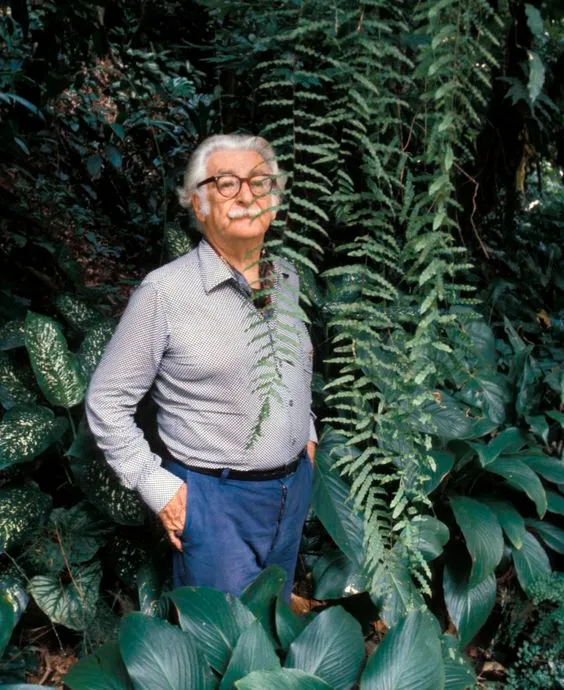
Roberto Burle Marx (1909–1994) was a visionary Brazilian landscape architect, artist, and environmentalist who revolutionized modern garden design by integrating native tropical flora with bold, abstract forms. Born in São Paulo and raised in Rio de Janeiro, his artistic sensibilities were shaped during his studies in Berlin, where he encountered Brazil's native plants in European botanical gardens, inspiring his lifelong commitment to ecological design. Collaborating with architects like Lúcio Costa and Oscar Niemeyer, Burle Marx crafted over 2,000 projects worldwide, including the iconic Copacabana Beach promenade and Brasília's public spaces. His designs broke from European traditions, favoring asymmetry, vibrant mosaics, and organic patterns that celebrated Brazil's biodiversity. Beyond landscaping, he was a prolific painter, sculptor, and tapestry designer, with his estate, Sítio Roberto Burle Marx, now a UNESCO World Heritage Site, serving as a testament to his interdisciplinary genius and environmental advocacy .